Test bench engineering & retrofit
Your test bench measures reliably and runs safely again, also with the new EU Machinery Regulation in mind.
New build or modernisation of existing machines, including safety concept and commissioning.
Test Bench Solutions
ENGtron supports development engineers in planning, building and automating test benches, and in carrying out tests on its own in-house test benches.
What ENGtron does
Four services, one contact: from testing on our own benches to a test bench at your site.
You quickly know whether range, power, cut-off and brakes deliver what the data sheet promises.
Development and regression tests on the roller test bench up to 60 km/h, for pedelecs and S-pedelecs.
More on e-bike testingEfficiency, endurance and load changes for motor, gearbox or robot joint, measured with DAkkS-calibrated sensors.
On the drivetrain test bench, with hardware-in-the-loop on request.
More on the drivetrain test benchYour test bench measures reliably and runs safely again, also with the new EU Machinery Regulation in mind.
New build or modernisation of existing machines, including safety concept and commissioning.
You get the source code and are no longer tied to expensive licence models.
Operator interface, test automation and real-time control, tailored to your test bench.
More on the test bench softwareTest bench software
Operator interface, test automation and real-time control, tailored to your test bench. No annual licence, and new features arrive when you need them, not when a vendor schedules them.
Not only for test benches: control and automation software for other machines too, regardless of who built them.
Testing focus
ENGtron takes over development-accompanying validation for Pedelec and S-Pedelec drive systems, from motor characterization to series readiness. No setup effort, no onboarding delay. Directly with the engineer.
Development-accompanying testing on our roller test bench up to 60 km/h: simulate road loads, determine range (R200), record the power curve, test thermal behaviour under sustained load, compare variants and de-risk decisions faster. Got a specific question? Talk to us about customer-specific tests, ENGtron reproduces your scenario reliably.
ENGtron compared DJI, Bosch, Pinion and further systems under identical R200 conditions. The benchmark reveals clear efficiency differences and helps prioritize development decisions faster.
Real R200 measurement (2025), identical conditions: 20 km/h, 70 W rider power. Specific consumption in Wh/km, development motor most efficient.
Schematic illustration. On the roller test bench the real cut-off behaviour is measured up to 60 km/h, reproducibly and under realistic load.
Second in-house test bench
A high-precision drivetrain test bench, expandable for system tests, for motors, gearboxes, complete drivetrains, robotic actuators and e-bike shifting systems (hub gears, derailleurs), with automated control and monitoring of the connected components, Hardware-in-the-Loop (HiL) with real-time simulation and DAkkS-calibrated torque sensing. Ideal for functional testing of robotics drives and actuators.

From torque calibration to endurance runs to full system tests: the bench drives, controls and monitors the complete drive system including battery, control units and further actuators, and tests it automatically. Reproducible test conditions, precise measurement technology and analysis by an engineer who knows his test bench.
Every link of this chain is known in detail because ENGtron dimensioned, built or programmed it. This applies to both in-house test benches.
Mechanical line
Control and data acquisition
Control quality made visible: setpoint step, measured response and ideal response after controller tuning and control target (schematic)
Schematic illustration: the DUT reading plotted against the DAkkS-traceable bench reference. Offset, slope and linearity errors become visible and can be corrected.
Third in-house test bench
Everyone describes the feel of a brake lever differently. On the brake test bench it becomes a characteristic curve: lever force, clamp force and lever travel, measured automatically and directly comparable with other brakes.
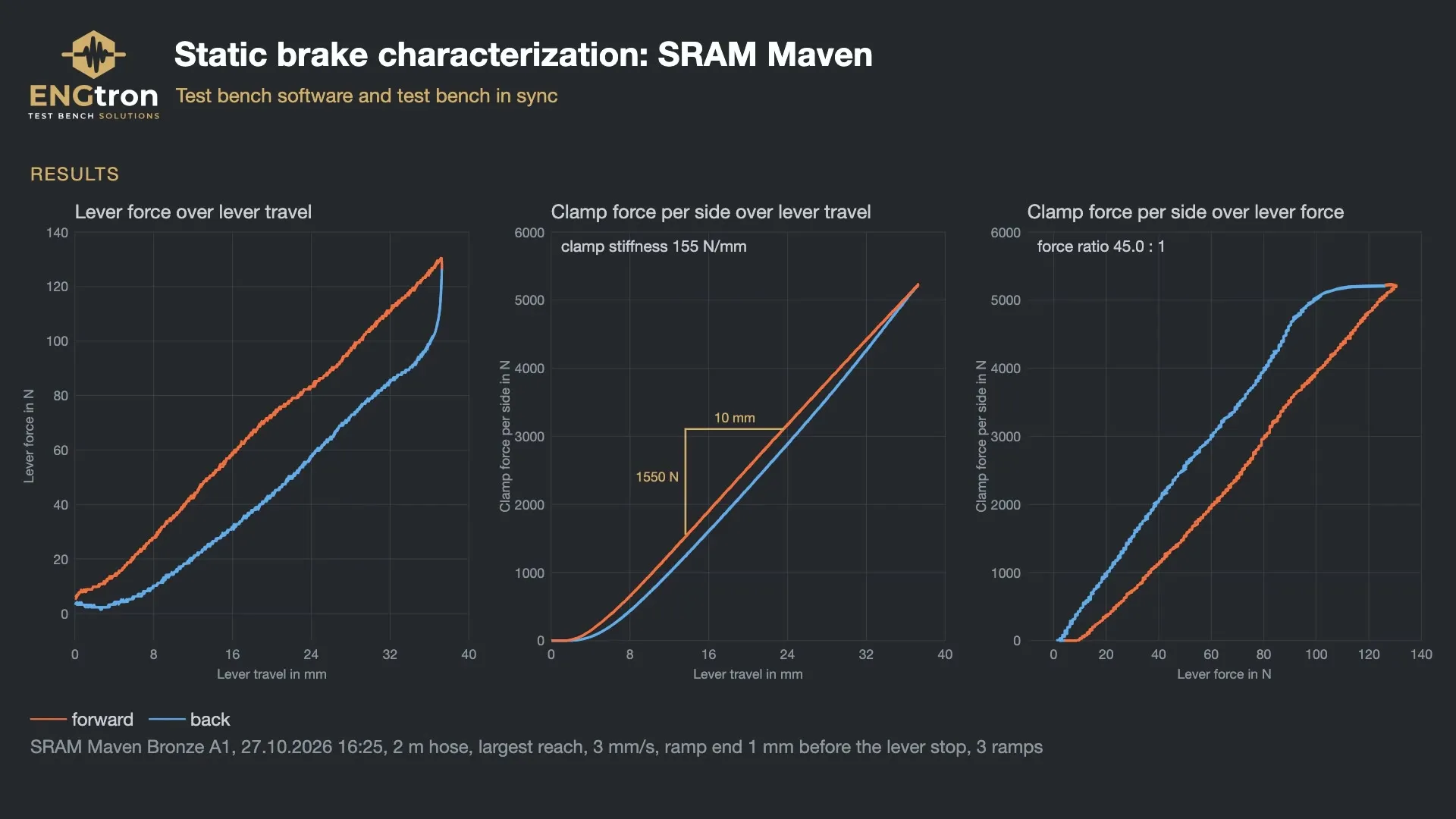
Clamp stiffness, force ratio and hysteresis per brake, from three ramps with an identical sequence. For the SRAM Maven that is 155 N/mm and 45 : 1.
Advantages
Lean structure, deep technical expertise, and direct engineer-to-engineer collaboration. No overhead, no middlemen, just precise engineering and reliable results.
FAQ
ENGtron in Metzingen performs development-accompanying testing of pedelecs and S-pedelecs on its own roller test bench up to 60 km/h, including functional tests according to DIN EN 15194: R200 range tests, cut-off behaviour at the speed limit, cadence-dependent power curves and DAkkS-calibrated torque measurement with speed capture. Contact: max@engtron.de.
In the R200 test the complete e-bike runs on the roller test bench under identical conditions: 20 km/h speed and 70 W rider power. The specific consumption in Wh/km is measured with DAkkS-calibrated torque sensing (HBM T210, 0.1%). This makes drive systems such as DJI, Bosch or Pinion directly and reproducibly comparable.
ENGtron validates motors, gearboxes, robotic actuators and complete drive systems on a drivetrain test bench with hardware-in-the-loop and real-time simulation: two DAkkS-calibrated HBM T210 torque sensors (200 Nm, 0.1%), Linux Real-Time with EtherCAT and 1 ms cycle time, automated endurance and regression tests according to the V-model.
Yes. ENGtron calibrates torque sensors DAkkS-traceably on its own drivetrain test bench: measuring range ±200 Nm with a reproducibility of ±0.2 Nm. The schematic calibration chart on this website shows how offset, slope and linearity errors become visible and can then be corrected.
Yes. On its own brake test bench ENGtron characterises disc brakes statically: a spindle pushes the brake lever in three ramps at 3 mm/s, force sensors measure lever force and clamp force. The result per brake is clamp stiffness, force ratio and hysteresis, so brakes, variants and prototypes can be compared directly.
No. ENGtron is not an accredited test body according to DIN EN ISO/IEC 17025. The services target development teams that need robust measurement data and reproducible results for internal development, variant comparisons and system optimization, without the formal effort of an accredited certification test and therefore at significantly lower cost.
In four steps: an initial call about your measurement task directly with the engineer, then a concept and quote with a realistic assessment of effort, precision and limits, followed by execution and measurement on our in-house test benches in Reutlingen or at your site, and finally solid data with clear recommendations. Requests: max@engtron.de.
Describe your task in two or three sentences, you will get an honest assessment of feasibility, effort and timing. No sales pitch, no detours.
Your project stays confidential. On request we work under NDA, gladly even before the first technical conversation.
Contact person: Maximilian Boger, M.Eng.
E-mail / Teams: max@engtron.de